
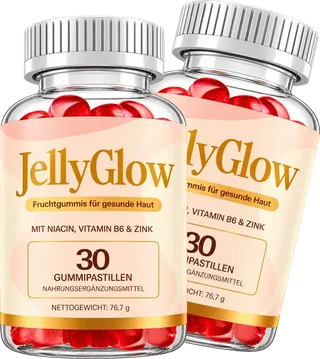
JellyGlow Gummies vitamin B6 amounts to 2 mg per gummy, supplied as pyridoxine hydrochloride. The label prints it as 143% of the EU reference value, which becomes about 118% on the US Daily Value scale. Below you'll find why the two numbers differ, how 2 mg sits against the adult upper limit, which medicines are worth a question, and how to total B6 across everything you take.
How much vitamin B6 is in JellyGlow Gummies?
Each gummy contains 2 mg of vitamin B6. At the label's dose of one gummy a day, that is 2 mg a day from this product, and a 30-gummy jar holds 60 mg in total.
Vitamin B6 is the second row of the label's Nutritional Information and one of the three nutrients named on the front: "WITH NIACIN, VITAMIN B6 & ZINC". The other two have their own pages, on niacin and zinc. For the whole panel at once, see the nutrition facts page.
What form of vitamin B6 do JellyGlow Gummies use?
The vitamin B6 is pyridoxine hydrochloride, the fourteenth of seventeen items on the ingredient list. It is a widely used form of the vitamin in supplements.
Its place near the end of the list simply reflects how little of it there is by weight: 2 mg in a gummy of roughly 2.6 g (76.7 g net weight divided by 30, our arithmetic). The ingredients above it include glucose syrup, sugar, maca extract and pectin. The ingredients page has the complete order.
080160 % NRV
NRV is the EU reference; US Daily Values give 156%, 118% and 14%. Neither is the safe upper limit: 35 mg niacin from supplements, 100 mg B6, 40 mg zinc (NIH ODS).
Show the numbers
| Item | Value |
|---|---|
| Niacin (B3) | 156% (25 mg) |
| Vitamin B6 | 143% (2 mg) |
| Zinc | 15% (1.5 mg) |
Source: JellyGlow label; FDA Daily Values; NIH Office of Dietary Supplements.
Why is JellyGlow Gummies vitamin B6 143% on the label but 118% in US terms?
The label measures 2 mg against the EU Nutrient Reference Value, while the US measures it against a Daily Value of 1.7 mg. Two different yardsticks give two percentages for the same amount.
FDA uses the Daily Value to show how much a serving contributes to a day's diet, and it sets the vitamin B6 figure at 1.7 mg.1 Dividing 2 by 1.7 gives about 118%. The EU reference is lower, which is why the label shows 143%. Neither number is wrong; they simply answer the question for different markets.
| Measure | Reference amount | 2 mg as a share |
|---|---|---|
| EU % NRV (printed on label) | EU reference value | 143% |
| US % Daily Value (our arithmetic) | 1.7 mg | about 118% |
| Adult RDA, ages 19–50 | 1.3 mg | about 154% |
| Adult upper limit | 100 mg | 2% |
How does 2 mg compare with the vitamin B6 adults need?
It is a little above the recommended amount for most adults. The NIH Office of Dietary Supplements gives an RDA of 1.3 mg a day for adults aged 19 to 50.2
That RDA is the amount intended to cover nearly all healthy people in that age group, so 2 mg is slightly more than that, but not by much. Many people already get vitamin B6 from ordinary foods, so a gummy's 2 mg usually lands on top of what your meals provide. That is a reason to count it, not a reason to worry.
080160 % of limit
One gummy keeps all three under their limits. A second gummy, or a multivitamin with niacin, can push niacin past its 35 mg limit from supplements, which NIH applies to nicotinamide too.
Show the numbers
| Item | Value |
|---|---|
| Niacin, 1 gummy | 71% of 35 mg |
| Niacin, 2 gummies | 143% of 35 mg |
| Zinc, 1 gummy | 4% of 40 mg |
| Vitamin B6, 1 gummy | 2% of 100 mg |
Source: JellyGlow label (amounts per gummy); NIH Office of Dietary Supplements (upper limits).
Is the vitamin B6 in JellyGlow Gummies near the upper limit?
No. One gummy provides 2 mg, which is 2% of the 100 mg adult upper limit the NIH sets for vitamin B6.2 Of the three nutrients on the front of the jar, B6 is by far the furthest from its ceiling.
That contrasts sharply with niacin, where one gummy already reaches about 71% of its limit. So if you are deciding which nutrient to keep an eye on, niacin is the tighter one. B6 still matters if you take high-dose products, as the next section explains.
What does the NIH say about high vitamin B6 intake?
The NIH warns that taking high amounts of vitamin B6 from supplements for a year or more can cause severe nerve damage.2 That warning is about high-dose supplements, far above the 2 mg in a gummy, but it is the reason to know your total.
Products sold as stand-alone B6, some B-complex formulas and some "stress" or sleep blends can contain many times the RDA. If you take one of these daily, add its B6 to the gummy's 2 mg and compare the total with 100 mg. If you notice anything unusual while taking any B6 product, stop and talk to your doctor.
How do you total vitamin B6 from JellyGlow Gummies and other products?
Add 2 mg for the gummy to the B6 in every other supplement you take each day, then compare the total with the 100 mg adult upper limit. The stacker below does the adding for you.
Enter the amounts printed on your other labels and it shows running totals for niacin, zinc and vitamin B6 against the adult upper limits (35 mg, 40 mg and 100 mg). It is a calculator, not a medical check; it can't see your health history or your medicines.
Tool · Stacker
Niacin, zinc and B6 stacker
One JellyGlow gummy is counted for you. Add what your multivitamin or other supplements list per day to see the total against the adult upper limits from NIH (35 mg niacin from supplements, 40 mg zinc, 100 mg vitamin B6). Bars run from 0 to 200% of each limit; the marker is 100%.
A worked example shows how the sum goes. Say you take one gummy (2 mg) and a B-complex that lists 25 mg of vitamin B6. Your daily total is 27 mg, which is 27% of the 100 mg upper limit. Add a separate sleep blend with another 50 mg and the total becomes 77 mg. Each product looks modest on its own; the total is what counts.
Labels where vitamin B6 often appears:
- Multivitamins and B-complex products
- Products sold for skin, hair or nails
- Sleep, "stress" and women's health blends
- Some fortified drinks and snack bars
Which medicines should you ask about with JellyGlow Gummies vitamin B6?
The NIH lists interactions between vitamin B6 and some medicines, including cycloserine and certain epilepsy drugs.2 If you take either, ask your pharmacist before adding a B6 product, even a small one.
Interactions between supplements and medicines can sometimes be serious, and NCCIH advises telling all your providers about every supplement you use.3 The label agrees in its own way: it asks you to consult a physician before use, especially if you take medication. Our medications page gathers the questions for all nine actives, and the safety page covers the label's cautions.
What does the seller say about vitamin B6 in JellyGlow Gummies?
The seller's page also quotes EU claim wording for zinc and vitamin B6, taken from the EU's list of permitted health claims.4 That wording is not printed on the label, and we don't repeat it as a claim.
The EU list defines which sentences a food may carry about a nutrient; it is not a study of this product. The label's only claim-type sentence is about niacin, explained on the skin claim page. The seller's page also says plainly that it does not promise anti-ageing effects, which fits our reading: the B6 is a listed nutrient with an amount, and that is what we report.
Who should check before taking JellyGlow Gummies for the vitamin B6?
The label says the product is not for people under 18 or for pregnant or nursing mothers, and that adults should consult a physician before use. Add to that anyone taking cycloserine, an epilepsy medicine or a high-dose B6 product.
A pharmacist can check your total B6 and your medicines in a few minutes. Bring the jar or a photo of the panel, and the labels of anything else you take.
Can you take JellyGlow Gummies for vitamin B6 during pregnancy?
No, not according to the label, which says the product is not for use by pregnant or nursing mothers. That rules it out regardless of how modest the B6 amount is.
Part of the reason lies in the other ingredients. NCCIH notes that many supplements have not been tested in pregnant or breastfeeding women, or in children.5 The gummy also contains plant extracts, and NCCIH notes that Asian ginseng, one of them, may be unsafe in pregnancy.6 If you need vitamin B6 during pregnancy, your doctor or midwife can recommend a product made for that purpose. Our who it's for page covers the label's age and pregnancy limits.
Where can you buy JellyGlow Gummies?
They are sold by an EU-based seller, and when we checked, the seller's shipping page listed Germany as its only delivery country. US delivery is not confirmed, so email [email protected] before ordering from anywhere else.
If the numbers on this page work for you, you can view the packs on the seller's page. When we checked, the seller's order buttons used an unfinished link; if a button fails, contact the helpdesk by email. The how to order page walks through the steps, or go to the seller's order page.
Questions people ask
What form of vitamin B6 is in JellyGlow Gummies?
Pyridoxine hydrochloride. It is listed fourteenth of seventeen ingredients on the label.
Why is the vitamin B6 in JellyGlow Gummies 143% on the label but 118% in the US?
The label uses the EU reference value, while the US Daily Value is 1.7 mg. The same 2 mg gives 143% on the EU scale and about 118% on the US scale.
Is the vitamin B6 in JellyGlow Gummies close to the upper limit?
No. One gummy supplies 2 mg, which is 2% of the 100 mg adult upper limit. Count it anyway if you take other B6 products.
Can JellyGlow Gummies interact with epilepsy medicine because of the B6?
The NIH lists interactions between vitamin B6 and certain epilepsy drugs. If you take one, ask your pharmacist before starting the gummies.
Does the seller make any vitamin B6 claim for JellyGlow Gummies?
The seller's page quotes EU claim wording for vitamin B6, but the label does not print it. We report it only as the seller's quotation, not as a claim of ours.
Sources for this page
- FDA: Daily Value on the Nutrition and Supplement Facts Labels. www.fda.gov
- NIH Office of Dietary Supplements: Vitamin B6, Fact Sheet for Consumers. ods.od.nih.gov
- NCCIH: Some Medication-Supplement Interactions Can Be Serious. www.nccih.nih.gov
- EUR-Lex: Commission Regulation (EU) No 432/2012, list of permitted health claims made on foods. eur-lex.europa.eu
- NCCIH: Using Dietary Supplements Wisely. www.nccih.nih.gov
- NCCIH: Asian Ginseng, Usefulness and Safety. www.nccih.nih.gov
These statements have not been evaluated by the Food and Drug Administration. This product is not intended to diagnose, treat, cure, or prevent any disease. Safety: JellyGlow Gummies are a food supplement sold in the EU, not a medicine. Adults 18+ only; the label says one gummy once a day and not to exceed it. Not for pregnant or nursing women. The panel lists niacin (as nicotinamide), vitamin B6, zinc, maca, L-citrulline, L-carnitine and small amounts of grape seed, Panax ginseng and rhodiola extracts, which can matter with diabetes, blood-thinning, blood pressure, seizure or antibiotic medicines or before surgery. Ask your doctor or pharmacist first, never stop prescribed treatment, and keep the jar away from young children. This site is an independently run information site about JellyGlow Gummies; the owner states it is a U.S. stocking partner for JellyGlow. It is not the maker or the seller. We may earn money when you order through links marked as sponsored. The seller is based in the EU and sets prices, shipping and refund terms; we show them as we found them, so confirm at the live checkout.
 30-day money-back guarantee
 No subscription
