
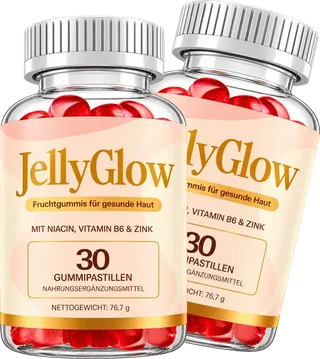
JellyGlow Gummies are a food supplement, not a medicine: a jar of 30 fruit gummies, one a day, listing niacin, vitamin B6, zinc, maca root extract and five smaller actives. Whether JellyGlow Gummies are safe for you depends on your age, any pregnancy, your medicines and what other supplements you take. This page gathers every safety point in one place, starting with the label's own cautions, and ends with what to bring to a pharmacist.
Are JellyGlow Gummies safe?
For a healthy adult who takes one gummy a day and no other niacin supplement, nothing on the label or in our sources points to a specific danger. That is not the same as a guarantee: the finished gummy has not been studied, and safety always depends on the person taking it.
The label itself narrows who should take it, and official sources add ingredient cautions on top. If you are pregnant or nursing, under 18, on prescription medicine, living with a medical condition or preparing for surgery, the honest answer is “ask first.” The sections below explain why.
Does FDA check JellyGlow Gummies for safety?
No. FDA does not approve dietary supplements for safety or effectiveness before they are sold; the companies that make and sell them are responsible for their products and labels.1 That applies to every supplement on the US market, not just this one.
JellyGlow Gummies are also labelled for the EU, as a food supplement distributed by the EU distributor printed on the label, Digistore24 MSLW Limited in Dublin. The label carries no seals or badges claiming FDA approval, and any page that shows one is not reflecting the label. In practice, the label, the seller's written terms and your own pharmacist are your main safety checks.
080160 % of limit
One gummy keeps all three under their limits. A second gummy, or a multivitamin with niacin, can push niacin past its 35 mg limit from supplements, which NIH applies to nicotinamide too.
Show the numbers
| Item | Value |
|---|---|
| Niacin, 1 gummy | 71% of 35 mg |
| Niacin, 2 gummies | 143% of 35 mg |
| Zinc, 1 gummy | 4% of 40 mg |
| Vitamin B6, 1 gummy | 2% of 100 mg |
Source: JellyGlow label (amounts per gummy); NIH Office of Dietary Supplements (upper limits).
What safety cautions are printed on the label?
The label prints five plain cautions, and they are the starting point for everyone. In the label's own terms:
- Dose: take one gummy once a day, and do not exceed the recommended dose.
- Age and pregnancy: not for use by those under 18 or by pregnant or nursing mothers.
- Medical advice: consult a physician before use, especially if taking a medication, having a medical condition or under medical supervision.
- Children: keep out of reach of young children.
- Seal: do not use if the safety seal is damaged or missing.
The label also says food supplements must not be used as a substitute for a varied and balanced diet and a healthy lifestyle, and asks you to store the jar in a cool, dry place below 30°C (86°F). Our label page shows the full text.
Why does keeping them away from children matter?
Gummies look and taste like sweets, so a child may eat several at once. A handful would deliver many times the label's adult serving of niacin, vitamin B6 and zinc.
Store the jar high up, close the cap after every use, and do not take your gummy in front of small children as if it were candy. If a child eats some, call your local poison control line or a doctor and have the jar to hand.
How much niacin, vitamin B6 and zinc is too much?
Each nutrient has an adult upper limit from official sources, and the limits apply to your total from all supplements combined, not to this gummy alone. One gummy uses up most of the niacin limit.
| Nutrient | One gummy | Adult upper limit | One gummy as share of limit |
|---|---|---|---|
| Niacin (as nicotinamide) | 25 mg | 35 mg a day from supplements and fortified food2 | 71% |
| Vitamin B6 | 2 mg | 100 mg a day3 | 2% |
| Zinc | 1.5 mg | 40 mg a day4 | about 4% |
The percentages are our arithmetic. NIH notes that the niacin limit covers nicotinamide as well as nicotinic acid, and that it does not apply when a doctor is supervising a higher dose.2 For vitamin B6, NIH says high supplement amounts taken for a year or more can cause severe nerve damage.3 For zinc, too much can cause nausea, dizziness, headaches and stomach upset.4
The practical risk is stacking. A multivitamin plus a B-complex plus one of these gummies can push niacin past the limit. Our side effects page has a calculator for exactly this.
Is it safe to take JellyGlow Gummies every day for months?
Daily use is what the label describes, one gummy once a day, and the seller suggests a routine of at least three months. Neither the label nor the seller sets a maximum duration, and no study has followed people taking this gummy over time.
What official sources do say concerns the nutrients at much higher amounts. NIH's warning about nerve damage applies to high-dose vitamin B6 taken for a year or more, and each gummy lists 2 mg against a 100 mg upper limit.3 For niacin, the daily limit is the same whether you take it for a week or a year, which is why long-term users should recheck their other supplements whenever they change them.
A sensible habit is to review your full supplement list with a pharmacist once a year, or whenever you start a new medicine.
What if you take two gummies by mistake?
One extra gummy on a single day takes niacin to 50 mg, above the 35 mg adult upper limit, but it is a one-off rather than a pattern.2 Go back to one gummy the next day and do not try to make up for missed days.
If you feel unwell afterward, or if you take several gummies, contact a pharmacist or doctor and have the jar to hand. A missed day needs no action at all: just take the next gummy at your usual time.
Can JellyGlow Gummies interact with medicines?
Some of the listed ingredients have interactions on record, and NCCIH warns that some medication–supplement interactions can be serious.5 That is why the label asks anyone on medication to consult a physician first.
Examples from official sources include zinc with certain antibiotics, vitamin B6 with some epilepsy drugs, and ginseng with medicines for blood sugar or clotting. Rather than repeat the full list here, our medications page sets out each pairing with its source. The screener below turns your situation into specific questions.
How do you work out which questions to ask a pharmacist?
Tick the medicines or conditions that apply to you, and the screener lists the ingredient-specific questions to bring to a pharmacist. It is a preparation aid, not medical advice, and it does not tell you whether to take the gummies.
Tool · Check first
Check-first screener
Tick anything that applies. You get the ingredient-specific questions to take to your pharmacist with the jar. It starts a conversation; it is not medical advice.
Nothing ticked yet. If none apply, still read the label and follow the serving.
Print or copy the questions, take the jar with you, and let the pharmacist read the full ingredient list.
Does “natural” mean JellyGlow Gummies are safe?
No. NCCIH points out that “natural” does not mean safe, and that some supplements can affect bleeding or how you respond to anesthesia.6 Several of the listed actives are plant extracts, including maca, Panax ginseng, grape seed and rhodiola.
NCCIH advises raising any supplement with your care team well before surgery, and notes that many supplements have not been tested in pregnancy, while breastfeeding or in children.6 If you have an operation or dental procedure booked, mention the gummies at your pre-op appointment. Our botanicals page describes each plant extract.
Should you tell your doctor you take JellyGlow Gummies?
Yes. NCCIH recommends telling all your health care providers about every supplement you use, so they can see the whole picture.56 It is easy to forget a gummy, precisely because it does not feel like a medicine.
A simple way to do it is to photograph the nutrition panel and keep it on your phone. Then you can show it at any appointment, including at the dentist or before blood tests.
Do JellyGlow Gummies replace sunscreen or skincare?
No. The seller's own FAQ says the product is not a substitute for sun protection, skincare or medical treatment, and the label's only skin wording is the EU claim note about niacin. Keep your sun protection exactly as it is.
If you have a skin concern, a clinician is the right person to see; a supplement is not a stand-in for that visit. Our skin claim page explains what the label's wording means and does not mean.
What should you check when the jar arrives?
Check the seal, the label and the best-before date before you open it. The label says not to use the product if the safety seal is damaged or missing, and the best-before date is printed on the bottom of the jar.
Also compare the gummies with the label. The jar photos show a German-language label, and the English label wrap carries the same panel, so either is normal. If anything looks wrong, do not eat them; email [email protected], and keep the jar for the 30-day guarantee from receipt.
What is the safest way to start?
Show the label to a pharmacist, count your other supplements, and if you go ahead, take one gummy a day with a meal. Stop and see a clinician if anything feels wrong.
Our who it's for page sums up who should not take the gummies. If you are clear to proceed, you can look at the packs on the seller's page when you are ready.
Questions people ask
Are JellyGlow Gummies safe during pregnancy?
The label says they are not for use by pregnant or nursing mothers. Several ingredients have little safety information in pregnancy, so talk to your midwife or doctor about any supplement.
Are JellyGlow Gummies safe for teenagers?
No. The label says they are not for use by anyone under 18.
Are JellyGlow Gummies safe with a multivitamin?
Possibly not, depending on the multivitamin. One gummy already supplies 71% of the adult niacin upper limit, so add up both labels and ask a pharmacist.
Are JellyGlow Gummies safe before surgery?
Tell your surgical team well in advance. NCCIH advises raising supplements before surgery, because some can affect bleeding or anesthesia.
Has FDA safety-tested JellyGlow Gummies?
No. FDA does not approve supplements for safety or effectiveness before they are sold; the maker is responsible.
Sources for this page
- U.S. Food and Drug Administration: Dietary Supplements. www.fda.gov
- NIH Office of Dietary Supplements: Niacin, Fact Sheet for Health Professionals. ods.od.nih.gov
- NIH Office of Dietary Supplements: Vitamin B6, Fact Sheet for Consumers. ods.od.nih.gov
- NIH Office of Dietary Supplements: Zinc, Health Professional Fact Sheet. ods.od.nih.gov
- NCCIH: Some Medication-Supplement Interactions Can Be Serious. www.nccih.nih.gov
- NCCIH: Using Dietary Supplements Wisely. www.nccih.nih.gov
These statements have not been evaluated by the Food and Drug Administration. This product is not intended to diagnose, treat, cure, or prevent any disease. Safety: JellyGlow Gummies are a food supplement sold in the EU, not a medicine. Adults 18+ only; the label says one gummy once a day and not to exceed it. Not for pregnant or nursing women. The panel lists niacin (as nicotinamide), vitamin B6, zinc, maca, L-citrulline, L-carnitine and small amounts of grape seed, Panax ginseng and rhodiola extracts, which can matter with diabetes, blood-thinning, blood pressure, seizure or antibiotic medicines or before surgery. Ask your doctor or pharmacist first, never stop prescribed treatment, and keep the jar away from young children. This site is an independently run information site about JellyGlow Gummies; the owner states it is a U.S. stocking partner for JellyGlow. It is not the maker or the seller. We may earn money when you order through links marked as sponsored. The seller is based in the EU and sets prices, shipping and refund terms; we show them as we found them, so confirm at the live checkout.
 30-day money-back guarantee
 No subscription
