
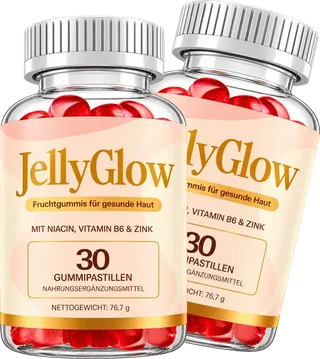
Do JellyGlow Gummies work? Nobody can say yet, because we found no published study of the finished gummy, and the label promises no result. What exists is research on single ingredients, usually at other doses and in other forms, plus one EU-wording statement on the label. This post separates those three layers so you can judge for yourself.
Is there a study of JellyGlow Gummies?
No, we found no published study, trial or lab report on JellyGlow Gummies as a finished product. The seller's page shows no reviews or before-and-after photos either, and says the product is new.
That absence is the honest starting point. It does not show the gummies do nothing, and it does not show they do something; it means the question has not been tested in public. Anyone offering you a confident yes or no is going beyond the evidence. Our how it works page describes what the label and seller actually say about the product.
What does the label itself say?
The label makes exactly one skin statement, printed as “† Niacin contributes to the maintenance of normal skin.” It sits under a gold band reading “Gummies for Healthy Skin†”.
That wording is taken from the European Union's register of permitted health claims on foods.1 It is a general statement about the nutrient niacin, not a measurement of these gummies. In the United States, FDA does not pre-approve this kind of statement, and a US label carrying one must say that FDA has not evaluated it.2 The label also says the supplement is not a substitute for a varied diet and a healthy lifestyle. For the full story of that wording, see our skin claim page.
What does ingredient research cover?
Ingredient research covers each ingredient on its own, and it is mostly limited. For the three largest botanical extracts on the label, public health agencies describe thin evidence, and the table lists what each one says.
| Ingredient | Amount per gummy | What the source says |
|---|---|---|
| Maca root 20:1 extract | 195 mg | Evidence is limited, with few small human trials3 |
| Panax ginseng root 20:1 extract | 2 mg | Most trials are small and short; short-term use appears safe for most4 |
| Rhodiola rosea root 20:1 extract | 1 mg | Evidence is not strong enough to say it helps any condition5 |
These findings describe the plant or nutrient, frequently at doses and forms that differ from a 2 mg or 1 mg extract in a gummy. We do not claim the small amounts are too little or enough; we simply have no source that says either. For a plain-language look at each one, see our ingredients page.
Why does the gap between ingredients and the finished gummy matter?
It matters because a finished gummy is a different thing from its parts. A research paper on ginseng root may use a much larger amount, a different preparation or a different group of people than a 2 mg extract inside a pectin gummy that also holds eight other actives.
Nothing in the public sources we read tests that combination. So the careful reading is that ingredient research tells you what each ingredient is and what cautions apply, and says little about what this particular gummy does. That is also why the cautions on our maca root page matter more than any promise: they are the part the sources can actually support.
What does the seller say it does not promise?
The seller says it does not promise anti-ageing effects, and its comparison table says the gummies do not remove wrinkles. Its FAQ also says the product is not a substitute for sun protection, skincare or medical treatment.
We report these as the seller's statements, and we think they are the right ones. FDA's own advice on sun protection is to limit time in the sun between 10 a.m. and 2 p.m., cover skin with clothing and a hat, and use sunscreen,6 and a supplement does not replace any of that. If you see a page or ad claiming dramatic changes, it did not come from the label or the seller's page.
How could you judge it for yourself?
If you try a supplement, the practical approach is to decide in advance what you will watch and to involve a clinician, rather than to rely on a feeling.
- Write down your reason for taking it and the date you start.
- Take one gummy a day as the label directs, and keep a short note of anything unusual.
- Show the jar to a pharmacist or doctor before you start, especially if you take medicines.
- Compare your notes at a set date, and stop and ask if anything worries you.
Ginseng, for example, may lower blood sugar and may interfere with blood clotting and some medicines, so a pharmacist's view matters.4 Our results page explains why we publish no timelines. When you are ready to compare packs, you can check the seller's page calmly and read the refund terms first.
Questions people ask
Do JellyGlow Gummies work for skin?
We cannot say. The only skin statement on the JellyGlow Gummies label is an EU-wording line about niacin, and we found no study of the gummy itself.
Is there research on the ingredients in JellyGlow Gummies?
Yes, but it covers single ingredients, often at other doses. For maca, ginseng and rhodiola the public sources we read describe limited evidence.
How long do JellyGlow Gummies take to work?
No source gives a timeline for JellyGlow Gummies, so we give none. The seller recommends at least three months for a steady routine, which is a suggestion about habit, not a promised result.
Do JellyGlow Gummies replace sunscreen?
No, and the seller says so too. JellyGlow Gummies are a food supplement, and sun protection advice from FDA is unchanged by taking one.
Sources for this page
- EUR-Lex: Commission Regulation (EU) No 432/2012, list of permitted health claims made on foods. eur-lex.europa.eu
- FDA: Structure/Function Claims. www.fda.gov
- Memorial Sloan Kettering Cancer Center: About Herbs, Maca. www.mskcc.org
- NCCIH: Asian Ginseng, Usefulness and Safety. www.nccih.nih.gov
- NCCIH: Rhodiola, Usefulness and Safety. www.nccih.nih.gov
- FDA: Sunscreen, How to Help Protect Your Skin from the Sun. www.fda.gov
These statements have not been evaluated by the Food and Drug Administration. This product is not intended to diagnose, treat, cure, or prevent any disease. Safety: JellyGlow Gummies are a food supplement sold in the EU, not a medicine. Adults 18+ only; the label says one gummy once a day and not to exceed it. Not for pregnant or nursing women. The panel lists niacin (as nicotinamide), vitamin B6, zinc, maca, L-citrulline, L-carnitine and small amounts of grape seed, Panax ginseng and rhodiola extracts, which can matter with diabetes, blood-thinning, blood pressure, seizure or antibiotic medicines or before surgery. Ask your doctor or pharmacist first, never stop prescribed treatment, and keep the jar away from young children. This site is an independently run information site about JellyGlow Gummies; the owner states it is a U.S. stocking partner for JellyGlow. It is not the maker or the seller. We may earn money when you order through links marked as sponsored. The seller is based in the EU and sets prices, shipping and refund terms; we show them as we found them, so confirm at the live checkout.
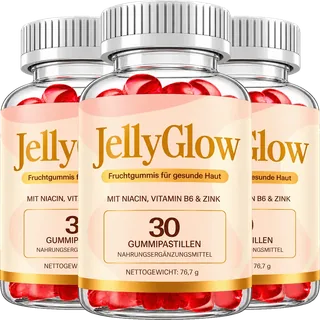
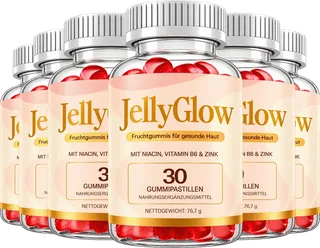
 30-day money-back guarantee
 No subscription
