
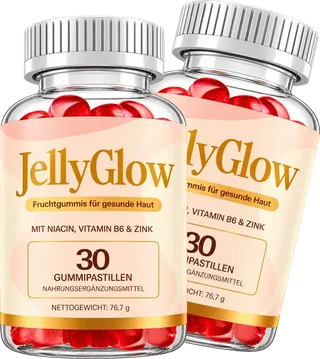
JellyGlow Gummies maca root content is 195 mg of a 20:1 maca extract in every gummy, according to the label's Nutritional Information. That makes maca the biggest active by weight, well ahead of the vitamins, the two amino acids and the three small plant extracts. This page explains what the label says about it, what the ratio means, and what an independent cancer center's herb database reports about maca as an ingredient.
How much maca root is in JellyGlow Gummies?
Each gummy contains 195 mg of maca root 20:1 extract, as printed on the label. The serving size is one gummy, so a full daily serving at the suggested use is also 195 mg.
The label lists the plant by its botanical name, Lepidium meyenii, and the row carries the note "no NRV established". That note means the EU has no Nutrient Reference Value for maca, so there is no percentage to compare it with. The same is true in the US, where Daily Values cover vitamins and minerals rather than plant extracts.
A jar holds 30 gummies, so one jar contains 30 servings of 195 mg each. That works out to 5,850 mg of the extract per jar, which is our arithmetic, not a figure printed on the jar. For the complete panel in one place, see the nutrition facts page.
Where does maca sit in the JellyGlow Gummies ingredient list?
Maca root extract is the fourth ingredient on the label, after glucose syrup, water and sugar. EU labels list ingredients in descending order of weight, so this tells you that maca is the heaviest ingredient after the gummy base itself.
Here is the start of the list exactly as the label orders it:
- Glucose syrup
- Water
- Sugar
- Maca (Lepidium meyenii) root 20:1 extract
- Gelling agent (pectin)
- Acidity regulator (citric acid)
- L-citrulline
The rest of the list continues with L-carnitine, nicotinamide, natural flavours, turmeric concentrate as a colouring food, carnauba wax, zinc citrate, pyridoxine hydrochloride and the three small botanical extracts. The full order, with notes on each item, is on the ingredients page.
0100200 mg
Maca extract makes up most of the listed active weight. Small amounts are shown as printed; we make no claim about what any amount does.
Show the numbers
| Item | Value |
|---|---|
| Niacin (B3) | 25 mg NE |
| Vitamin B6 | 2 mg |
| Zinc | 1.5 mg |
| Maca | 195 mg |
| L-Citrulline | 35 mg |
| L-Carnitine | 25 mg |
| Grape seed | 2 mg |
| Ginseng | 2 mg |
| Rhodiola | 1 mg |
Source: JellyGlow label, Nutritional Information.
What does "20:1" mean on the JellyGlow Gummies maca row?
A 20:1 ratio is a concentration figure stated by the maker, usually read as 20 parts of dried raw root used to make 1 part of finished extract. It describes how the extract was produced, not how strong its effect is.
We cannot check that ratio. The label states it, but no certificate or method for the maca extract is shown on the label or on the seller's page. Different producers also use different solvents and drying steps, so two "20:1" extracts may not be alike. The fair reading is simple: the gummy contains 195 mg of a powder that the maker says came from roughly twenty times that weight of root.
The same "20:1" note appears on the ginseng, grape seed and rhodiola rows. Those are covered on the botanicals page.
How does maca compare with the other actives in JellyGlow Gummies?
Maca is by far the largest active, at 195 mg against a combined total of about 93.5 mg for the other eight. The second largest, L-citrulline, is 35 mg.
| Active (per gummy) | Amount | Note on the label |
|---|---|---|
| Maca root 20:1 extract | 195 mg | no NRV established |
| L-Citrulline | 35 mg | no NRV established |
| Niacin (B3) | 25 mg NE | 156% NRV |
| L-Carnitine | 25 mg | no NRV established |
| Vitamin B6 | 2 mg | 143% NRV |
| Grape seed 20:1 extract | 2 mg | no NRV established |
| Panax ginseng root 20:1 extract | 2 mg | no NRV established |
| Zinc | 1.5 mg | 15% NRV |
| Rhodiola rosea root 20:1 extract | 1 mg | no NRV established |
The 93.5 mg figure is our sum of the label amounts, counting niacin's 25 mg NE as 25 mg. The panel explorer below lets you tap any row, including maca, to see the amount, the NRV or US %DV where one exists, and the official source we use for it.
Tool · Panel explorer
Tap a row of the Nutritional Information
The nine rows printed on the label, per gummy. Bars show milligrams on one linear scale from 0 to 200 mg, so you can see how much of the gummy's actives is maca. Tap a row for the EU NRV, the US Daily Value and the official note.
Pick a row.
What is maca root?
Maca is a Peruvian plant in the cabbage family, grown for its root.1 Memorial Sloan Kettering Cancer Center (MSK) keeps a consumer page on maca in its herb database, and that page is the source we rely on here.
The root has a long history as a food in the Andes. In supplements it usually appears as a dried powder or a concentrated extract, as in this gummy. The label does not say which color type of maca root was used or where it was grown, and the seller's page adds nothing on that point.
What does research say about maca as an ingredient?
MSK describes the evidence on maca as limited, based on a few small human trials.1 That research looked at maca in its own forms and doses, not at JellyGlow Gummies.
No published study of the finished gummy was found when we checked. So nothing on this page should be read as a claim that the maca in this product does anything for you. The seller does not claim a maca-specific effect either; the only health wording on the label is the niacin note behind the dagger, explained on the label page.
FDA does not approve dietary supplements for safety or effectiveness before they are sold, and makers are responsible for their own products and labels.2 That is one more reason to read ingredient research as background, not as a promise.
What side effects have been reported with maca?
MSK lists menstrual changes, moodiness, cramps, stomach irritation and insomnia among the effects reported with maca.1 These reports concern maca in general and say nothing certain about a 195 mg dose in a gummy.
- Stomach irritation or cramps
- Trouble sleeping (insomnia)
- Changes in the menstrual cycle
- Moodiness
If you notice anything unusual after starting a new supplement, stop and talk to a doctor or pharmacist. You can also report problems with a supplement to FDA.2 Our side effects page gathers the reported effects for every active on the panel.
Can maca in JellyGlow Gummies affect lab tests?
Maca may interfere with testosterone lab tests, according to MSK.1 If you have blood work coming up, tell the person ordering it that you take a product containing maca.
This is a practical point rather than a health claim. Lab staff and clinicians can only interpret results well when they know everything you take, so keep a short written list of your supplements and bring it to appointments.
Who should talk to a provider before taking maca?
Anyone with a medical condition, a prescription or a pregnancy should check first, and MSK singles out one group in particular. Do not skip that conversation if you have a hormone-sensitive cancer, which is the group MSK says should talk to their provider before using maca.1
The JellyGlow Gummies label adds its own cautions. It says the product is not for use by anyone under 18 or by pregnant or nursing mothers, and that adults should consult a physician before use, especially if taking a medication, having a medical condition or being under medical supervision.
NCCIH points out that "natural" does not mean safe, and that many supplements have not been tested in pregnancy, breastfeeding or children.3 It also notes that some medication and supplement interactions can be serious, so all your providers should know what you take.4 Our medications page and the safety overview go further.
How do you take the maca in JellyGlow Gummies?
You take it as part of the gummy: one gummy once a day for adults, as the label directs. There is no separate maca dose to adjust, and the label says not to exceed the recommended amount.
The seller's page suggests taking it at the same time each day, for example after breakfast. Doubling up after a missed day would also double the niacin, which matters because of the upper limit for that vitamin. The how-to-use page covers missed days, storage and the label's other directions.
Where can you buy JellyGlow Gummies with maca root?
The product is sold by an EU-based seller, on a German-language page, and that seller's shipping page lists delivery to Germany only. Delivery to the United States is not confirmed.
If you are in the US, ask the helpdesk at [email protected] before ordering whether they ship to you. When you are ready, you can see the packs on the seller's page, or read our pricing page first for the totals per pack.
When we checked, the seller's order buttons used an unfinished link. If a button fails, contact the helpdesk rather than retrying on another site.
What should you check on the jar you receive?
Check that the panel on your jar matches the one described here, with 195 mg of maca root 20:1 extract per gummy. The jar photos show a German-language label, and the English label wrap carries the same panel.
Look for the intact safety seal, 30 gummies per jar, the best-before date on the bottom, and the Netherlands returns address. If anything does not match, write to the helpdesk before you open the jar. When you have what you need, you can go to the seller's order page or keep reading on the ingredients page.
Questions people ask
How many milligrams of maca root are in one serving of JellyGlow Gummies?
One serving is one gummy, and it contains 195 mg of maca root 20:1 extract. The label shows no NRV for maca because none has been set.
Is maca the main active ingredient in JellyGlow Gummies?
By weight, yes: at 195 mg it is the largest of the nine listed actives. That says nothing about effect; it only describes how much is in each gummy.
Can the maca in JellyGlow Gummies change a testosterone blood test?
MSK says maca may interfere with testosterone lab tests. Tell whoever orders your blood work that you take a product containing maca.
Does the label on JellyGlow Gummies say where the maca comes from?
No. The label gives the botanical name Lepidium meyenii and the 20:1 ratio, but no origin, root color or extraction method.
Should I avoid JellyGlow Gummies maca root if I am pregnant?
The label says the product is not for pregnant or nursing mothers. Talk to your doctor or midwife about any supplement during pregnancy.
Sources for this page
- Memorial Sloan Kettering Cancer Center: About Herbs, Maca. www.mskcc.org
- U.S. Food and Drug Administration: Dietary Supplements. www.fda.gov
- NCCIH: Using Dietary Supplements Wisely. www.nccih.nih.gov
- NCCIH: Some Medication-Supplement Interactions Can Be Serious. www.nccih.nih.gov
These statements have not been evaluated by the Food and Drug Administration. This product is not intended to diagnose, treat, cure, or prevent any disease. Safety: JellyGlow Gummies are a food supplement sold in the EU, not a medicine. Adults 18+ only; the label says one gummy once a day and not to exceed it. Not for pregnant or nursing women. The panel lists niacin (as nicotinamide), vitamin B6, zinc, maca, L-citrulline, L-carnitine and small amounts of grape seed, Panax ginseng and rhodiola extracts, which can matter with diabetes, blood-thinning, blood pressure, seizure or antibiotic medicines or before surgery. Ask your doctor or pharmacist first, never stop prescribed treatment, and keep the jar away from young children. This site is an independently run information site about JellyGlow Gummies; the owner states it is a U.S. stocking partner for JellyGlow. It is not the maker or the seller. We may earn money when you order through links marked as sponsored. The seller is based in the EU and sets prices, shipping and refund terms; we show them as we found them, so confirm at the live checkout.
 30-day money-back guarantee
 No subscription
