
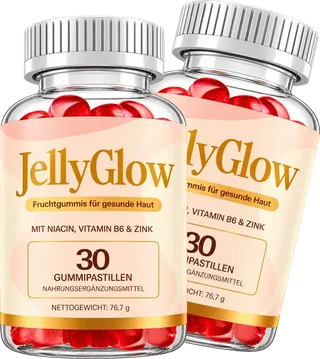
JellyGlow Gummies ginseng, grape seed and rhodiola appear as three small plant extracts on the label: 2 mg of Panax ginseng root 20:1 extract, 2 mg of grape seed 20:1 extract and 1 mg of Rhodiola rosea root 20:1 extract per gummy. Together they come to 5 mg, the smallest group on the panel. This page lists each one with what the National Center for Complementary and Integrative Health (NCCIH) reports about it, and the questions worth raising with a pharmacist.
Which botanical extracts are in JellyGlow Gummies?
There are three: Panax ginseng root, grape (Vitis vinifera) seed and Rhodiola rosea root, each as a 20:1 extract. A fourth plant, maca root, is also on the label, but at 195 mg it is in a different league and has its own maca root page.
| Extract (per gummy) | Amount | Ingredient position | NRV |
|---|---|---|---|
| Panax ginseng root 20:1 extract | 2 mg | 15th | no NRV established |
| Grape (Vitis vinifera) seed 20:1 extract | 2 mg | 16th | no NRV established |
| Rhodiola rosea 20:1 root extract | 1 mg | 17th, last | no NRV established |
All three sit at the very end of the ingredient list, after the zinc and vitamin B6 sources. Because EU labels list ingredients by descending weight, their position matches their small amounts. Our ingredients page shows the whole list in order.
How much of each botanical is in a jar of JellyGlow Gummies?
A 30-gummy jar holds 60 mg of ginseng extract, 60 mg of grape seed extract and 30 mg of rhodiola extract. Those jar totals are our arithmetic from the per-gummy rows.
We report these amounts without judging them. There is no source we can cite that says 1 or 2 mg of these extracts is too little or enough for any purpose, so we make neither claim. What we can say is that ginseng and grape seed match vitamin B6 at 2 mg, and rhodiola, at 1 mg, is the lightest of all nine actives, below even the 1.5 mg of zinc.
0100200 mg
Maca extract makes up most of the listed active weight. Small amounts are shown as printed; we make no claim about what any amount does.
Show the numbers
| Item | Value |
|---|---|
| Niacin (B3) | 25 mg NE |
| Vitamin B6 | 2 mg |
| Zinc | 1.5 mg |
| Maca | 195 mg |
| L-Citrulline | 35 mg |
| L-Carnitine | 25 mg |
| Grape seed | 2 mg |
| Ginseng | 2 mg |
| Rhodiola | 1 mg |
Source: JellyGlow label, Nutritional Information.
What does "20:1" mean for these extracts?
It is a concentration ratio the maker states, commonly read as about 20 parts of raw plant material used per 1 part of extract. We cannot verify it, because no certificate or method is shown on the label or the seller's page.
The ratio describes processing, not potency or effect. Two extracts with the same ratio can differ in solvent, plant part and quality. The maca root page explains the ratio in a little more depth.
What is Panax ginseng, and what does NCCIH say about it?
Panax ginseng, also called Asian ginseng, is the plant whose root is used in this extract. NCCIH describes the evidence on it as limited, with most trials small and short.1
NCCIH's safety notes are the part most worth reading:
- Short-term use appears safe for most people.1
- The most common side effect reported is trouble sleeping (insomnia).1
- It may lower blood sugar, which matters for people with diabetes or anyone on medicines that lower it.1
- It may interfere with blood clotting and with some medicines.1
- It may make autoimmune disorders worse.1
- It may be unsafe during pregnancy.1
All of this refers to ginseng studied in its own forms and doses, not to this gummy. Keep that distinction in mind whenever you read about any single ingredient.
What is grape seed extract, and what does NCCIH say about it?
Grape seed extract is made from the seeds of grapes (Vitis vinifera). NCCIH says it is generally well tolerated when taken by mouth, and that research results on it vary and are not definite.2
NCCIH advises talking to your health care provider about grape seed extract if you take any medicine.2 It also notes that little is known about its safety in pregnancy.2 The label already says the product is not for pregnant or nursing mothers.
What is rhodiola, and what does NCCIH say about it?
Rhodiola rosea is a flowering plant, used here as a root extract. NCCIH says the evidence is not strong enough to show that rhodiola helps with any health condition.3
On safety, NCCIH reports that rhodiola is possibly safe when used for up to 12 weeks, and that reported side effects include dizziness, headache, trouble sleeping, dry mouth or extra saliva.3 An interaction has been reported with losartan, a blood pressure medicine.3 Little is known about rhodiola in pregnancy.3
Do these botanicals interact with medicines?
They may: NCCIH flags possible interactions for ginseng and rhodiola and advises checking with a provider about grape seed if you take medicine. NCCIH also says more generally that some medication and supplement interactions can be serious, so every provider should know what you take.4
| Extract | Medicine or condition NCCIH mentions |
|---|---|
| Panax ginseng | Diabetes and blood-sugar medicines, blood clotting and blood thinners, some other medicines, autoimmune disorders, pregnancy |
| Grape seed | Any medicine (talk to your provider), pregnancy |
| Rhodiola | Losartan (blood pressure), pregnancy |
The screener below helps you prepare for that talk. Tick the medicines or conditions that apply to you and it returns ingredient-specific questions to bring to a pharmacist. It does not give medical advice or tell you whether to take the product.
Tool · Check first
Check-first screener
Tick anything that applies. You get the ingredient-specific questions to take to your pharmacist with the jar. It starts a conversation; it is not medical advice.
Nothing ticked yet. If none apply, still read the label and follow the serving.
Should you stop these botanicals before surgery?
Tell your surgical team about them well ahead of time. NCCIH notes that some supplements can affect bleeding or anesthesia, so they should be raised well before any operation.5
Ginseng's possible effect on clotting is one reason this applies here, even at a small amount, because your surgical team is the one who should weigh it. Your surgeon or anesthesiologist will tell you when, or whether, to pause. The medications page and the safety page carry this point for the whole panel.
Does research on ginseng, grape seed or rhodiola apply to JellyGlow Gummies?
No: the research NCCIH summarizes looked at each plant on its own, usually in other doses and forms. No published study of the finished gummy was found when we checked.
The seller makes no claim for these three extracts, and neither do we. The label's only health statement is the dagger note about niacin, which is EU claim wording. Read our how it works page for an honest account of what the panel can and cannot tell you.
NCCIH also cautions that "natural" does not mean safe.5 A plant extract in a gummy is still an active ingredient, and that is the right frame for thinking about it.
What do the botanical rows not tell you?
The rows tell you the plant, the ratio and the amount, and very little else. That is typical of a food supplement label, but it leaves real gaps you should know about.
- No supplier, country of origin or harvest information is printed for any of the three.
- No standardization is given, meaning the label does not say how much of any particular plant compound each extract contains.
- No certificate of analysis for the botanicals is shown to buyers.
- No purpose is stated; the seller does not say why the three extracts were included.
None of this makes the product unusual, and none of it is a warning sign by itself. It simply means you are relying on the maker's label. If any of these details matter to you, email [email protected] and ask before you buy. Check the gummies you receive against the panel on the jar, which should match the one described here. The label page explains how to read every panel on the wrap.
Who should be most careful with these botanicals?
People with diabetes, a bleeding disorder, an autoimmune condition or a prescription for losartan should talk to a clinician first, based on NCCIH's notes. The label's own exclusions add anyone under 18 and pregnant or nursing mothers.
The label also asks adults to consult a physician before use if taking a medication, having a medical condition or being under medical supervision. NCCIH points out that many supplements are untested in pregnancy, breastfeeding and children.5 Our side effects page brings all the reported effects together in one table.
How can you get JellyGlow Gummies if you have checked with your provider?
They are sold by an EU-based seller on a German-language page, and the seller lists delivery to Germany only. US shipping is not confirmed, so ask the helpdesk at [email protected] before ordering from outside Germany.
When we checked, the order buttons used an unfinished link, so contact the helpdesk if one fails. You can look at the packs on the seller's page, or read the pricing page first and then return to the seller's order page when ready.
Questions people ask
How much Panax ginseng is in JellyGlow Gummies?
Each gummy lists 2 mg of Panax ginseng root 20:1 extract. A full jar of 30 gummies holds 60 mg (our arithmetic).
Can I take JellyGlow Gummies if I am on losartan?
Ask your prescriber or pharmacist first. NCCIH reports an interaction between rhodiola and losartan, and each gummy lists 1 mg of rhodiola extract.
Is the grape seed in JellyGlow Gummies the same as grapeseed oil?
No. The label lists grape (Vitis vinifera) seed 20:1 extract at 2 mg, which is an extract, not an oil.
Do JellyGlow Gummies contain anything that affects blood sugar?
NCCIH says Panax ginseng may lower blood sugar, and the gummy lists 2 mg of it. The gummy base also contains glucose syrup and sugar, so ask your clinician if you manage diabetes.
Why are the botanicals listed last on JellyGlow Gummies?
EU labels list ingredients by descending weight. At 1 to 2 mg each, the three extracts are the lightest ingredients, so they come last.
Sources for this page
- NCCIH: Asian Ginseng, Usefulness and Safety. www.nccih.nih.gov
- NCCIH: Grape Seed Extract, Usefulness and Safety. www.nccih.nih.gov
- NCCIH: Rhodiola, Usefulness and Safety. www.nccih.nih.gov
- NCCIH: Some Medication-Supplement Interactions Can Be Serious. www.nccih.nih.gov
- NCCIH: Using Dietary Supplements Wisely. www.nccih.nih.gov
These statements have not been evaluated by the Food and Drug Administration. This product is not intended to diagnose, treat, cure, or prevent any disease. Safety: JellyGlow Gummies are a food supplement sold in the EU, not a medicine. Adults 18+ only; the label says one gummy once a day and not to exceed it. Not for pregnant or nursing women. The panel lists niacin (as nicotinamide), vitamin B6, zinc, maca, L-citrulline, L-carnitine and small amounts of grape seed, Panax ginseng and rhodiola extracts, which can matter with diabetes, blood-thinning, blood pressure, seizure or antibiotic medicines or before surgery. Ask your doctor or pharmacist first, never stop prescribed treatment, and keep the jar away from young children. This site is an independently run information site about JellyGlow Gummies; the owner states it is a U.S. stocking partner for JellyGlow. It is not the maker or the seller. We may earn money when you order through links marked as sponsored. The seller is based in the EU and sets prices, shipping and refund terms; we show them as we found them, so confirm at the live checkout.
 30-day money-back guarantee
 No subscription
