
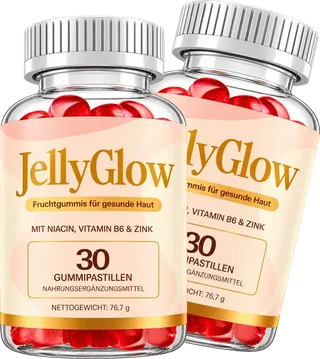
EU health claims explained in one sentence: the European Union keeps a list of exact wordings that food and supplement labels are allowed to use, and a statement that matches the list is permitted wording, not proof about a particular product.1 The JellyGlow Gummies label carries one such statement, marked with a dagger. Knowing how that list works, and how FDA sees the same words in the US, keeps the line easy to read without over-reading it.
What is the EU list of permitted health claims?
It is a legal register of approved wordings, published in Regulation (EU) No 432/2012, that sellers may use on foods when the conditions attached to each wording are met.1 The list sets out which phrases are permitted, not which products have been tested.
That distinction is the heart of the matter, and it is the one most often lost when a phrase is copied from a label into an advertisement. A wording appears on the list because the nutrient in general was assessed for that statement, and the product carrying it is a separate question. The regulation is an allowed-phrases document; it is not a study of the finished gummy, and nothing on it tells you how a particular jar performs.
What does the dagger note on the JellyGlow Gummies label say?
The label prints a dagger beside the band “Gummies for Healthy Skin†” and a note reading “† Niacin contributes to the maintenance of normal skin.” That is the only skin statement on the label, and it is EU claim wording from the permitted list.1
We quote it only as printed. It names a nutrient, niacin, and uses the list's own phrasing. We do not read it as a promise of any outcome, and we make no skin claims of our own. The label's capital-letter warning adds that food supplements must not be used as a substitute for a varied and balanced diet and a healthy lifestyle, which is a useful frame for any claim wording. The seller's page also quotes EU claim wording for zinc and vitamin B6, but those lines are not on the label. Our skin claim page goes through the wording line by line.
How does FDA see the same wording in the US?
In the US, a statement like this counts as a structure/function-type statement, which FDA does not pre-approve, and a US label carrying one must say that FDA has not evaluated it and that the product is not intended to diagnose, treat, cure or prevent any disease.2 The English label wrap we read is an EU label and does not carry that US statement.
More broadly, FDA states that it does not approve dietary supplements for safety or effectiveness before sale, and that makers are responsible for their products and labels.3 The two systems therefore work differently: the EU maintains a pre-set list of wordings, while the US relies on makers to stand behind their claims. If you want the plain-language version of what this means for the jar, our label page reads the printed panel and the caution text in order.
| Question | EU approach | US approach |
|---|---|---|
| Who sets allowed wording? | A published list of permitted claims | No pre-approval of structure/function statements |
| Required disclaimer | Wording must match the list | FDA-not-evaluated statement |
| Who answers for the label? | Not covered by the list itself | The maker |
| Does it prove a product works? | No | No |
How much evidence must a claim have?
Claims about health need competent and reliable scientific evidence, according to the FTC, and that standard covers endorsements and testimonials too.4 The point holds in the US whichever label wording a product uses.
For a reader, that translates into a calm rule. A matching phrase on a label shows the words are permitted somewhere; it does not show that this product delivered anything to you. If a page, an ad or a reviewer goes beyond the label, ask what the evidence is. The seller's own page says plainly that it does not promise anti-ageing effects, and we found no study of the gummy itself.
What can a reader take from claim wording?
You can take three things: which nutrient the wording concerns, where the phrase comes from, and what has not been shown. You cannot take a prediction about your own results.
A short checklist helps:
- Find the nutrient named in the claim and look at its amount on the panel.
- Check whether the claim is printed on the label or only quoted by the seller.
- Remember that permitted wording is not a test of the product.
- Notice whether a page repeats the label's words exactly or adds new ones.
- Compare the amount with the upper limit and talk to a pharmacist if you take medicines.
If you want the amounts, our nutrition facts page lists every row on the panel. The seller lists delivery to Germany only and US shipping is not confirmed, so see the seller's page for current terms before you plan a purchase.
Questions people ask
What does the dagger on the JellyGlow Gummies label mean?
It links the band to a note at the foot of the panel quoting EU claim wording about niacin. It points to the permitted-wording list, not to a result.
Is the claim on JellyGlow Gummies approved by FDA?
No. FDA does not pre-approve this kind of statement, and a US label carrying one must say FDA has not evaluated it.2 The JellyGlow Gummies label we read is an EU label.
Do JellyGlow Gummies carry other EU claims on the jar?
The label prints only the niacin statement. The seller's page also quotes EU claim wording for zinc and vitamin B6, and those quotes are the seller's, not ours.
Has anyone studied JellyGlow Gummies themselves?
We found no study of the finished gummy. Research we cite elsewhere concerns single ingredients, often at other doses, so it is not a finding about this product.
Sources for this page
- EUR-Lex: Commission Regulation (EU) No 432/2012, list of permitted health claims made on foods. eur-lex.europa.eu
- FDA: Structure/Function Claims. www.fda.gov
- U.S. Food and Drug Administration: Dietary Supplements. www.fda.gov
- Federal Trade Commission: Health Products Compliance Guidance. www.ftc.gov
These statements have not been evaluated by the Food and Drug Administration. This product is not intended to diagnose, treat, cure, or prevent any disease. Safety: JellyGlow Gummies are a food supplement sold in the EU, not a medicine. Adults 18+ only; the label says one gummy once a day and not to exceed it. Not for pregnant or nursing women. The panel lists niacin (as nicotinamide), vitamin B6, zinc, maca, L-citrulline, L-carnitine and small amounts of grape seed, Panax ginseng and rhodiola extracts, which can matter with diabetes, blood-thinning, blood pressure, seizure or antibiotic medicines or before surgery. Ask your doctor or pharmacist first, never stop prescribed treatment, and keep the jar away from young children. This site is an independently run information site about JellyGlow Gummies; the owner states it is a U.S. stocking partner for JellyGlow. It is not the maker or the seller. We may earn money when you order through links marked as sponsored. The seller is based in the EU and sets prices, shipping and refund terms; we show them as we found them, so confirm at the live checkout.
 30-day money-back guarantee
 No subscription
